

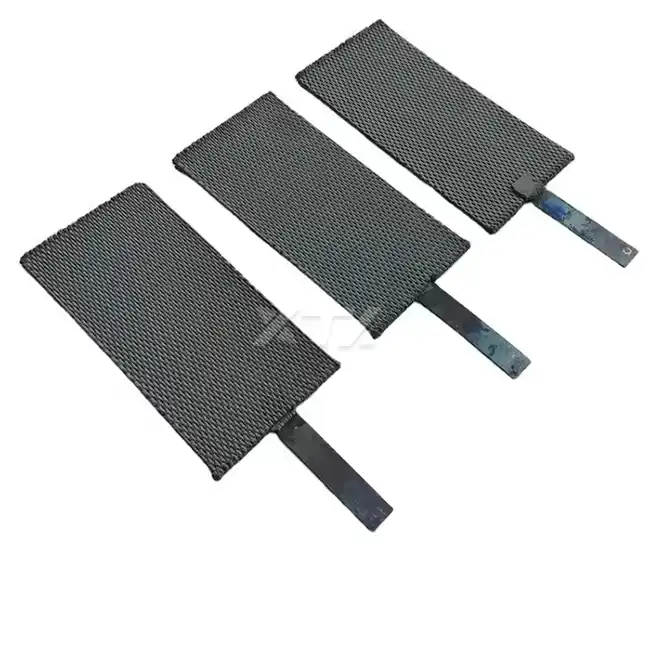
Lead Dioxide Titanium Electrode
Width: ≤ 1000mm
Length: ≤ 2000mm 100µm - 500µm Electrolysis, metal plating, oxidation process
Lead dioxide titanium rod anode: ASTM B348 Gr1 pure titanium Diameter: 10mm - 50mm
Length: 100mm - 1500mm 100µm - 500µm Sulfuric acid electrolysis, chlor-alkali industry, precious metal recovery
Lead dioxide titanium mesh anode: ASTM B265 Gr1 pure titanium Mesh size: 3×6mm / 6×12mm / 12×25mm
Thickness: 1mm - 3mm 100µm - 500µm Organic electrolysis, oxidation reaction, wastewater treatment
Lead dioxide titanium tube anode: ASTM B338 Gr1 pure titanium
Outer diameter: 10mm - 50mm
Wall thickness: 0.5mm - 2.5mm
Length: 50mm - 1500mm 100µm - 500µm Electrolytic synthesis, strong oxidizing environment, seawater electrolysis
Lead dioxide titanium wire anode: ASTM B265 Gr1 pure titanium Diameter: 1mm - 3mm
Length: customizable 100µm - 500µm Precious metal extraction, electrolytic water treatment, fine chemicals Working current density 100-1000 A/m²
Working environment pH 0 - 14
Oxidation potential 1.8V (vs. NHE)
Service life 2 - 10 years (depending on coating thickness and environment)
- Product Description
Lead Dioxide Titanium Electrode: High-Performance Solution for Industrial Applications
Baoji Xintailai Metal Co., Ltd. is a leading manufacturer and supplier of high-quality 【Lead Dioxide Titanium Electrodes】. Our company boasts a professional R&D team, skilled production personnel, and state-of-the-art equipment. We combine these strengths with rigorous quality control and third-party testing to deliver superior products and exceptional door-to-door service.
1. Product Introduction
【Lead Dioxide Titanium Electrodes】 are advanced electrochemical components designed for superior performance in various industrial applications. These electrodes feature a titanium substrate coated with lead dioxide, offering exceptional durability and efficiency in harsh environments.
2. Product Specifications
| Parameter | Specification |
|---|---|
| Substrate | Titanium Grade 1 or 2 |
| Coating | Lead Dioxide (PbO2) |
| Thickness | 1-5 mm (customizable) |
| Size | Up to 1000 x 2000 mm (customizable) |
| Operating Temperature | -10°C to 60°C |
| pH Range | 1-14 |
| Current Density | Up to 10 kA/m² |
| Lifetime | 3-5 years (application dependent) |

3. Product Features
- High corrosion resistance
- Excellent electrical conductivity
- Long service life
- Stable performance in harsh conditions
- Customizable dimensions and coatings
- Environmentally friendly operation
4. Product Advantages
- Superior durability compared to traditional electrodes
- Reduced energy consumption in electrochemical processes
- Lower maintenance requirements and operational costs
- Consistent performance throughout the electrode's lifespan
- Compliance with international environmental standards
- Versatility across multiple industrial applications
5. Product Application Industries
【Lead Dioxide Titanium Electrodes】 find extensive use in various industries:
- a) Wastewater Treatment:
- Electrochemical oxidation of organic pollutants
- Disinfection of industrial effluents
- Heavy metal removal from contaminated water
- b) Electroplating and Surface Finishing:
- Anodic oxidation processes
- Electrodeposition of metals
- Surface treatment of alloys
- c) Chemical Production:
- Electrosynthesis of organic and inorganic compounds
- Chlor-alkali production
- Manufacture of hydrogen peroxide
- d) Metal Refining:
- Electrowinning of copper, zinc, and other metals
- Electrolytic purification of ores
- Recovery of precious metals from industrial waste
- e) Energy Storage:
- Development of advanced battery technologies
- Fuel cell components
- Electrochemical capacitors
Be used in a wide range of industries.

Chemical Processing

Marine Engineering

Medical Devices

Desalination Plants

Aerospace

Energy
Factory and Production Sites
 |  |  |  |  |
 |  |  |  |  |
6. Product Manufacturing Process
- Titanium substrate preparation and cleaning
- Surface activation through etching and sandblasting
- Application of intermediate layers for enhanced adhesion
- Electrodeposition of lead dioxide coating
- Heat treatment for improved coating stability
- Quality control and performance testing
- Customization and final inspection
7. OEM Service
At Baoji Xintailai Metal Co., Ltd., we offer comprehensive OEM services for 【Lead Dioxide Titanium Electrodes】:
- Custom dimensions and shapes
- Tailored coating compositions
- Specialized performance characteristics
- Packaging and labeling options
- Technical support and consultation
- Prototype development and testing
8. FAQ
Q1: What is the typical lifespan of a Lead Dioxide Titanium Electrode?
A1: The lifespan varies depending on the application, but generally ranges from 3 to 5 years under normal operating conditions.
Q2: Can these electrodes be used in seawater applications?
A2: Yes, our 【Lead Dioxide Titanium Electrodes】 are suitable for seawater applications due to their excellent corrosion resistance.
Q3: How do I determine the right electrode size for my application?
A3: Our technical team can assist you in selecting the optimal electrode size based on your specific requirements and process parameters.
Q4: Are these electrodes environmentally friendly?
A4: Yes, 【Lead Dioxide Titanium Electrodes】 are designed for environmentally friendly operation, with minimal waste generation and high efficiency.
Q5: What maintenance is required for these electrodes?
A5: These electrodes require minimal maintenance. Regular inspection and occasional cleaning are typically sufficient to ensure optimal performance.
9. Contact Us
For inquiries about our 【Lead Dioxide Titanium Electrodes】 or to discuss your specific needs, please don't hesitate to reach out:
Tel & WhatsApp: +86-15319223116 / +8613335492266
Email: [email protected]
Address: Guojia Village Industrial Park, Maying Town, High-tech Development Zone, Baoji City, Shaanxi Province, China
Trust Baoji Xintailai Metal Co., Ltd. for high-quality 【Lead Dioxide Titanium Electrodes】 that meet your industrial challenges. Contact us today to elevate your electrochemical processes!